
Call us now :08071780343
 Send Inquiry
 Send Inquiry
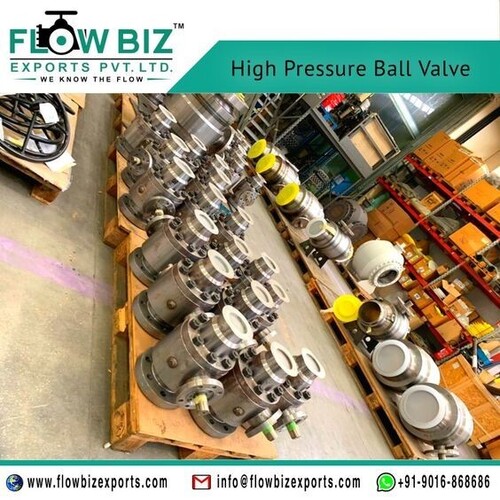
Best High Pressure Ball Valve Manufacturer in Pune
Price 1400.0 INR/ Piece
MOQ : 1 Piece
Best High Pressure Ball Valve Manufacturer in Pune Specification
- Caliber
- High Pressure
- Connection
- Threaded, Flanged, Welded
- Structure
- Ball Valve
- Pressure
- Up to 6000 PSI
- Channels
- 2 Way, 3 Way
- Material
- Stainless Steel, Carbon Steel, Brass
- Power
- Manual
- Media
- Water, Oil, Gas, Air
- Temperature of Media
- -20°C to 180°C
- Port Size
- 1/2 inch to 4 inch
- Flange
- ANSI, DIN
- Finish
- Polished
- Application
- Industrial, Chemical, Oil & Gas, Water Treatment
- Corrosion Resistance
- High
- Valve Type
- Full Bore and Reduced Bore
- Seat Material
- PTFE/Viton/Metal
- Leakage Class
- Class VI
- Operation Type
- Quarter Turn
- Mounting Options
- Panel, ISO 5211
- Handle Type
- Lever or Gear
- End Connection Standards
- BSP, NPT, Socket Weld, Butt Weld
- Test Pressure
- 1.5x Working Pressure
Best High Pressure Ball Valve Manufacturer in Pune About
High-Pressure & Isolation Ball Valves | FlowBiz Valves
FlowBiz Valves is a premier, engineering-driven manufacturer, supplier, and global exporter of heavy-duty High-Pressure and Isolation Ball Valves in India. Operating from our advanced manufacturing divisionswith an extensive technical distribution matrix across Pune, Maharashtra, and pan-Indiawe engineer these critical isolation components to anchor high-stress industrial applications.
Designed to endure severe physical pressures, intense thermal cycles, and aggressive media, our high-pressure series combines premium materials with cutting-edge safety features. From rapid-acting quarter-turn manual line isolation to automated process control configurations, these valves deliver absolute reliability where standard utility valves risk casing failure or seal blowout.
Technical Specifications & Compliance Matrix
Our high-pressure series is precision-machined from certified raw stock to satisfy rigid international safety and pressure containment criteria:
| Parameter | Technical Specification & Engineering Limits |
| Design Compliance | Fully engineered in strict compliance with ASME B16.34 standards |
| Material Availability | Solid forged design in ASTM A182 F304 / F316 / A350 LF2 |
| Size & Port Formats | Available in both Full Bore and Regular (Reduced) Port size vectors |
| Seat Polymer Selection | Premium PEEK (Polyether Ether Ketone) severe-service seats |
| Thermal Operating Envelope | Flawless physical stabilization from -20C to 180C |
| Quality Validation Testing | 100% hydrostatically and pneumatically verified per API 598 protocols |
| Test Pressure Ratings | Tested rigorously at 1.5x maximum working pressure |
| Fugitive Emissions Certified | Maximum 100 PPM low-emission warranty compliance |
| Isolation Rating | ANSI/FCI 70-2 Leakage Class VI (Absolute bubble-tight containment) |
Advanced Stem Design & Ultra-Low Emission Features
The moving stem assembly is a frequent vulnerability for dynamic packing degradation and fugitive emissions in high-pressure loops. To ensure permanent external containment and absolute operator field safety, FlowBiz utilizes an advanced stem architecture:
1. Live-Loaded, Blowout-Proof Stem
Engineered with an internal, bottom-entry mechanical shoulder, the stem cannot be ejected or blown out under high internal line pressures. This blowout-proof architecture is paired with live-loaded stem seals using a stack of pre-compressed Belleville spring washers. These washers continuously adjust for packing wear and thermal expansion, maintaining a constant mechanical load and eliminating the need for frequent manual gland adjustments.
2. High-Pressure Delrin Thrust Washer
To prevent structural binding, uneven seat wear, and erratic operating torque under extreme hydraulic forces, a specialized Delrin thrust washer is positioned beneath the stem shoulder. Delrin exhibits high mechanical yield strength, minimal moisture absorption, and an incredibly low coefficient of friction. This prevents deformation under high pressure, ensuring smooth, low-torque operation and extending the lifecycle of the internal components.
3. Redundant Stem O-Rings for Ultra-Low Emissions
To fulfill our strict Maximum 100 PPM emission warranty, the stuffing box incorporates additional stem O-rings alongside standard fire-safe compression packings. This multi-layered, redundant sealing arrangement acts as an ultra-low emission barrier, capturing volatile organic compounds (VOCs) and micro-leakages before they can escape to the atmosphere, protecting both your process lines and the environment.
4. Integrated Anti-Static Design
High-velocity fluid friction moving through pipeline valves can generate significant static electricity. Our integrated anti-static device maintains permanent electrical continuity between the ball, stem, and valve body, safely discharging static build-up to prevent sparks when handling flammable media or operating in hazardous refinery zones.
Safety Engineering & Advanced Sealing Trims
Premium PEEK High-Pressure Seats
Achieving long-term valve durability requires matching the seat polymer to the specific physical forces of your process. While standard PTFE is ideal for lower pressures, our high-pressure line utilizes premium PEEK (Polyether Ether Ketone) seats. PEEK is a high-performance thermoplastic that offers high mechanical strength, resistance to cold flow distortion, and excellent stability under intense hydraulic loads up to 180C, ensuring bubble-tight Class VI shut-off.
Certified Fire-Safe Architecture with Graphite Seals
Essential for high-risk industrial, chemical, and petrochemical plants handling volatile mediums. In the event of an unexpected facility fire that destroys the primary soft PEEK seats, our certified fire-safe design engages backup metal-to-metal sealing boundaries. High-purity graphite seals within the body joints and stuffing box withstand extreme heat, keeping volatile process fluids safely contained and minimizing hazardous external leakage.
Flexible Configuration & Mounting Vector Matrix
FlowBiz isolation ball valves are engineered to integrate seamlessly into complex new capital layouts or existing pipeline retrofits:
                         Valve Layout & Connections


 Flow Channels              Integration End Caps         Mounting Adaption

           Two-Way Standard         Screwed (BSP/NPT)        Panel Mount (Skids)
           Three-Way Multiport      Specialized Tube Ends    ISO 5211 (Automation)
                                      Welded (SW / BW)
-
Flow Channels: Available in Two-Way configurations for standard line isolation or Three-Way configurations to manage complex diverting, mixing, or bypass routing.
-
End Connections: Choose from Screwed (BSP/NPT) ends, specialized Tube Ends for instrumentation, Socket Weld (SW), or Butt Weld (BW) ends compatible with international ANSI or DIN flange standards.
-
Mounting Adaptations: Features convenient Panel Mounting holes for localized control panels or analytical skids. Additionally, an integrated ISO 5211 mounting pad cast into the top works enables direct-mount installation of pneumatic cylinders or electric motorized actuators without requiring custom brackets.
Frequently Asked Questions (FAQs)
Q: Why is a solid forged design (F304/F316/LF2) preferred over cast steel for high-pressure isolation?
A: High-pressure pipelines create intense mechanical forces that exert continuous stress on a valve's pressure boundary. While cast steel can contain hidden internal micro-porosities, sand holes, or cooling cracks that risk structural failure under stress, forged steel is compressed under extreme mechanical force. This refines the metal's grain structure, eliminates internal voids, and creates a highly uniform, dense metallurgy that safely contains high-pressure fluids. Selecting LF2 specifically ensures exceptional impact toughness down to -20C for cold outdoor installations.
Q: When should I choose a Full Bore versus a Regular (Reduced) Port ball valve?
A: The selection depends entirely on your system's fluid dynamics and pressure allowances:
-
Full Bore Valves: The internal diameter through the rotating ball matches the connected pipeline exactly. When fully opened, it creates an unobstructed path that keeps pressure drops near zero and allows for inline piggingideal for high-capacity transfer piping and viscous process lines.
-
Regular (Reduced) Port Valves: Feature a slightly smaller internal bore than the pipeline diameter. While this introduces a minor flow restriction, it allows for a more compact, lower-weight valve body that significantly reduces equipment costs in systems where minor pressure drops are acceptable.
Q: What distinct advantage does proof-testing at 1.5x maximum working pressure provide?
A: At our Pune manufacturing facility, 100% of our production line undergoes rigorous quality control and hydrostatic proof-testing at 1.5x the valve's rated working pressure in strict accordance with API 598 protocols. This process checks the structural density of the shell and the sealing integrity of the internal seats under extreme overpressure scenarios, verifying that every valve delivers a certified Class VI absolute zero-leakage performance before leaving our factory.
Q: Why choose FlowBiz as your long-term high-pressure valve partner in Pune?
A: Operating from Pune, FlowBiz Valves balances precision severe-service engineering with strict compliance to global validation benchmarks like ASME B16.34 and API 598. By utilizing traceable, premium forged material grades, offering certified low-emission warranties under 100 PPM, and providing flexible mounting options (Panel / ISO 5211), we eliminate field reliability concerns. Our capacity to deliver high-quality, customized high-pressure isolation valves tailored to your exact piping layout makes us a trusted supply chain partner across India and global export markets.
Tell us about your requirement

Price:
Quantity
Select Unit
- 50
- 100
- 200
- 250
- 500
- 1000+
Additional detail
Mobile number
Email

More Products in Ball Valve Category
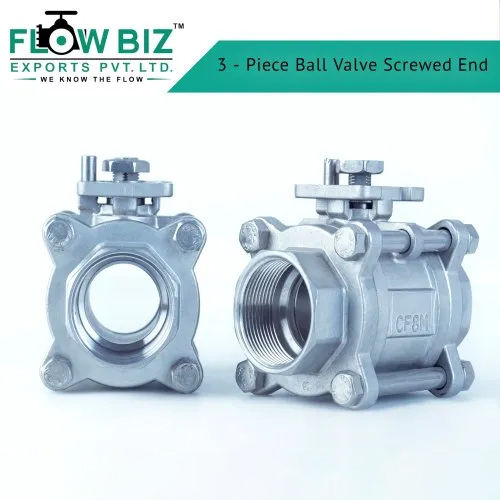
Three Piece Screwed End Ball Valves
Price 469 INR / Unit
Minimum Order Quantity : 10 Units
Application : Industrial
Material : Brass
Media : Gas
Finish : Polished

Cryogenic Ball Valve
Price 1000 INR / Unit
Minimum Order Quantity : 1 Unit
Application : Industrial
Material : Stainless Steel
Finish : Polished
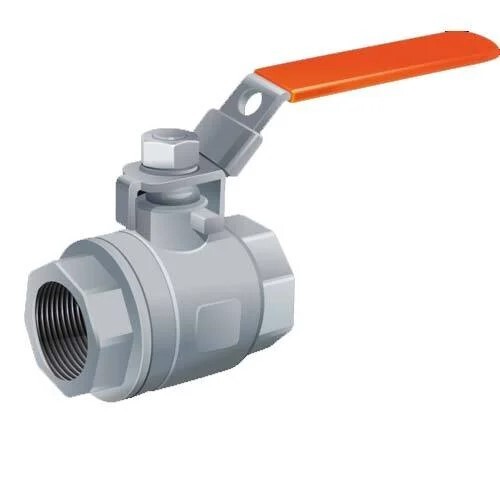
Industrial Flow Control Ball Valve
Price 1500.0 INR / Piece
Minimum Order Quantity : 1 Piece
Application : Air, Liquid , Gas
Material : Stainless Steel
Media : Water
Finish : Plain
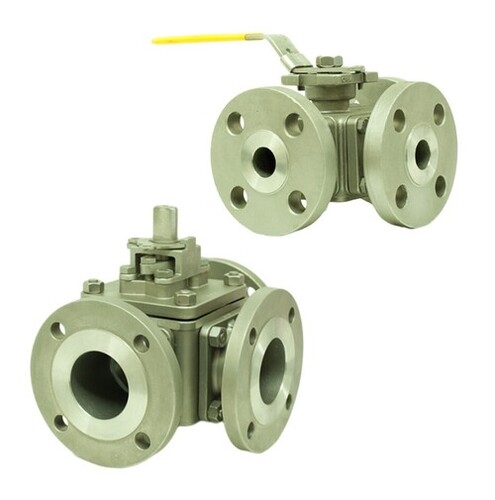
Multi-Port 3-way 4-way Ball Valve
Price 1500 INR / Unit
Minimum Order Quantity : 1 Number
Application : Air, Liquid , Gas
Material : Stainless Steel
Media : Water
Finish : Plain

 Send Inquiry
Our Products
- Needle Valve
- Ball Valve
- Globe Valve
- Gate Valve
- Y Type Strainer
- Piston Valve
- Check Valve
- Sight Glass
- Butterfly Valve
- Swing Check Valve
- Damper Valve
- Basket Strainer
- Pressure Reducing Valve
- Double Block Bleed Valve
- Moisture Separator
- Forged Valve
- Diaphragm Valve
- Mini Ball Valve
- Forbes Marshall PRV
- T Type Strainer
- Plug Valve
- Blow Down Valve
- Air Valve
- Non Return Valve
- Safety Valve
- Steam Trap
- Gasket
- L&T Ball Valve
- L&T Butterfly Valve
- AUDCO Ball Valve
- SPIRAX Marshall PRV
- Solenoid Valve
- oxygen
- roto seal coupling
- straight union
- flow control
- ptfe sheets
- ptfe
- rubber products
- felt products
- Asbestos products
- Engineered plastics products
- rubber seals
- rubber gasket
- Sight Glasses
- Jacketed Valves
- flush bottom valve
- strainer
- Sluice Gate Valve
- Slab Gate Valve
- PTFE Lined Valve
- PTFE Lined Valves


416,417 4th Floor, A Block Safal 8, Ajit Mill, Cross Rd, Rakhial,Ahmedabad - 380023, Gujarat, India

Mr Shakir Ansari
(Director)
Mobile :08071780343
 Send Inquiry
 Send SMS
 Call Me Free
Developed and Managed by Infocom Network Private Limited.
